Signed in as:
filler@godaddy.com

Africa Automotive, Transport & Mobility 2026 is moving from “market access” to “market creation” — from importing vehicles to building regional mobility ecosystems, supply chains, manufacturing capacity, digital platforms and investible industrial value chains.
Africa’s automotive, transport and mobility market is entering a structural transition from a predominantly import-dependent, used-vehicle and road-transport economy towards a more integrated manufacturing, logistics, public-transport, digital-mobility and new-energy ecosystem. The underlying macroeconomic environment remains supportive: the African Development Bank projects 4.2% continental GDP growth in 2026, following estimated growth of 4.4% in 2025, although tighter financial conditions, geopolitical tensions and supply-chain disruptions continue to constrain investment capacity. Africa nevertheless remains significantly underpenetrated in automotive manufacturing. In 2025 the continent produced approximately 1.23 million vehicles, around 1.3% of global output, with South Africa and Morocco accounting for more than 91% of production. This concentration highlights both the maturity of the leading automotive hubs and the substantial white space for localisation, assembly, components, commercial vehicles, mobility services and regional supply chains across other African markets.
The strategic opportunity is therefore less about simply expanding conventional vehicle sales and more about building an integrated African mobility industrial ecosystem encompassing vehicle manufacturing and assembly, components, batteries, charging and swapping infrastructure, public transport, logistics, fleet management, digital platforms, road and rail infrastructure, aftermarket services, financing and mobility-as-a-service. AfCFTA implementation, regional economic corridors and growing investment in transport infrastructure provide the foundations for this transition. The World Bank's 2026 integration agenda explicitly emphasises regional production hubs, lower logistics costs, simplified customs and standards, transport corridors and cross-border value chains.
The medium-term outlook is characterised by industrialisation, regionalisation, electrification and digitalisation. Africa is starting from a low automotive-production base, creating significant headroom for expansion. The continental automotive policy ambition is to increase production towards 4–5 million vehicles by 2035, including new-energy vehicles and associated components. Achieving this will require much deeper supplier localisation, competitive financing, reliable energy and logistics, stronger standards and greater intra-African trade.
The market is therefore likely to evolve into several interconnected mobility ecosystems: South Africa–SACU/SADC, Morocco–North Africa–Europe, Egypt–North Africa–Middle East, West African/ECOWAS manufacturing and mobility hubs, and East African mobility and logistics corridors. AfCFTA can increasingly connect these ecosystems into a wider continental production and consumption market.
By 2030–2035, the competitive frontier is likely to move beyond conventional automotive manufacturing towards EVs, batteries, critical-mineral beneficiation, intelligent transport systems, connected fleets, autonomous and assisted mobility technologies, digital logistics, rail integration, smart cities and circular mobility. Africa's strategic advantage will depend on whether it can convert its minerals, demographics and growing demand into productive capacity, regional value chains and globally competitive businesses rather than remaining primarily a destination for imported vehicles and mobility technologies.
The central 2026 market intelligence finding is that Africa's automotive opportunity is fundamentally a value-chain opportunity rather than simply a vehicle-sales opportunity. The combination of a 1.23-million-unit manufacturing base, strong economic growth, very high used-vehicle dependence, underutilised West African assembly capacity, accelerating EV adoption, critical-mineral resources, AfCFTA implementation and expanding transport infrastructure creates a multi-layered investment market.
For investors and businesses, the priority should be to identify bankable regional platforms that combine manufacturing, strategic sourcing, local supplier development, logistics, financing, technology and market access. For governments, the key requirement is to convert automotive policy from isolated national incentives into coordinated regional industrial strategies. For OEMs and technology companies, the strategic prize is to build scalable African ecosystems around vehicles + components + energy + infrastructure + data + finance + services. The emerging market structure favours organisations capable of integrating these dimensions and executing across borders.
SSCG Automotive and Mobility provides integrated Intelligence, Advisory and Consulting Services to help automotive manufacturers, OEMs, suppliers, investors, mobility operators and governments navigate industry transformation, identify growth opportunities and strengthen competitiveness.
Combining strategic and market intelligence, technology insights, consumer and ownership intelligence, business excellence and transformation expertise, SSCG delivers evidence-based insights and practical strategies across automotive manufacturing, supply chains, electric vehicles (EVs), connected and autonomous vehicles, future mobility, infrastructure and emerging markets. Our approach connects Data, Insight, Intelligence, Foresight and Strategy to measurable business value, supporting market entry, investment decisions, product development, innovation, operational excellence and sustainable growth.
Through flexible Fractional Leadership, Managed Services and MaaS (Management-as-a-Service) models, SSCG extends beyond traditional consulting to provide hands-on expertise, specialist capabilities and execution support without the overhead of building permanent teams. We help clients develop and implement strategies, manage transformation programmes, strengthen business and operational performance, accelerate product and technology development, and establish sustainable growth capabilities. Whether through strategic advisory, project-based consulting, fractional executive leadership or ongoing managed services, SSCG delivers scalable, cost-effective and results-oriented solutions that translate strategic priorities into measurable outcomes.

Enabling automotive businesses and investors to understand African markets, identify commercial opportunities, assess competitive dynamics and accelerate sustainable growth.
Helping automotive businesses and investors develop growth strategies, assess investment opportunities, transform operations and deliver measurable improvements in business performance, operational excellence and sustainable value creation.
Helping automotive businesses develop winning product strategies, accelerate innovation, manage new product development and translate emerging technologies and customer needs into commercially viable products.
Helping automotive businesses, investors, manufacturers and policymakers develop African automotive markets, strengthen local supplier capabilities, improve cross-border trade and build competitive, integrated regional automotive value chains.
Helping automotive businesses, investors, manufacturers and suppliers access UK and African markets, develop strategic partnerships, facilitate cross-border trade and investment, and build competitive, resilient automotive supply chains.
Helping automotive businesses plan, govern and deliver complex engineering projects and programmes, aligning technical requirements, resources, costs, timelines, quality and risk to achieve successful product and technology outcomes.
Helping automotive businesses manage product and technical risks, improve quality and reliability, optimise warranty performance, strengthen aftersales operations and reduce lifecycle costs while enhancing customer confidence and commercial performance. .
SSCG provides programme management, PMO, project delivery and technical coordination services for electric vehicle systems, battery energy storage systems and charging infrastructure. We help investors, developers, OEMs, energy companies, fleet operators and infrastructure providers translate investment plans into deliverable projects through robust governance, integrated planning, technical risk management, supplier coordination, cost and schedule control, commissioning and performance assurance.
SSCG supports automotive manufacturers, mobility technology companies, fleet operators, infrastructure providers and investors in developing, integrating and commercialising next-generation mobility technologies. Our focus spans connected vehicle systems, intelligent mobility platforms, vehicle electrification, digital services, mobility data and systems integration helping organisations accelerate innovation, strengthen technical capabilities and translate emerging technologies into commercially viable solutions. .
SSCG helps automotive OEMs, suppliers, dealerships, mobility providers and automotive technology businesses harness AI, digital technologies and intelligent systems to improve operational performance, accelerate innovation and strengthen competitiveness. We combine technology strategy, business transformation, digital engineering and implementation advisory to translate technology investments into measurable business outcomes.
SSCG helps automotive manufacturers, OEMs, suppliers, dealerships, mobility providers and technology businesses strengthen corporate governance, manage enterprise-wide risks and establish effective compliance frameworks. We support organisations in identifying, assessing and mitigating strategic, operational, financial, technological, supply-chain, product and regulatory risks while improving accountability, resilience, control effectiveness and sustainable business performance.
SSCG helps automotive manufacturers, OEMs, component suppliers, distributors and investors strengthen manufacturing capabilities, optimise supply chains and embed sustainability across the automotive value chain. We combine industrial strategy, operational excellence, supply-chain transformation, circular economy principles and ESG advisory to improve productivity, resource efficiency, resilience and competitiveness while supporting responsible growth and long-term value creation.

Join the online SSCG Africa Automotive & Mobility Strategic Intelligence Forum 2027
Date: Wednesday, 24 March 2027
Format: Online International Forum
Theme: Transforming Africa's Automotive Industry. Accelerating Mobility Innovation. Driving Sustainable Growth.

Africa's automotive and mobility industry represents one of the continent's most significant opportunities for industrialisation, manufacturing diversification, technology development, regional economic integration and sustainable economic growth.
The industry is entering a period of structural transformation. Rising urbanisation, population growth, increasing demand for transportation, expanding regional trade, digitalisation, new mobility business models and the global transition towards electric and connected vehicles are reshaping its competitive landscape.
Explore the SSCG Africa Automotive Market Intelligence Outlook 2026 for forward-looking insights, intelligence and strategic perspectives on Africa’s rapidly evolving automotive market. The report examines market trends, competitive dynamics, consumer demand, EV and mobility transformation, manufacturing and supply-chain opportunities, investment flows, technology adoption, policy and regulatory developments, and emerging market opportunities equipping automotive leaders, investors, OEMs, suppliers and policymakers with the intelligence to anticipate change, identify growth opportunities and make smarter, evidence-based decisions across Africa’s automotive value chain.
Strengthening Africa’s Micromobility and E-Mobility Sub-Sector for Resilience requires a coordinated strategy to develop affordable, accessible, commercially viable and sustainable transport ecosystems, with particular emphasis on electric motorcycles, bicycles, three-wheelers, scooters, light electric vehicles, shared mobility, urban logistics and last-mile delivery. Africa’s micromobility market offers considerable potential, supported by rapid urbanisation, growing populations, demand for affordable transport and the extensive use of motorcycle taxis and informal mobility services. The scale of the opportunity is significant: Africa has an estimated 27 million two- and three-wheelers, representing an annual market of approximately US$4.8 billion, while electric two-wheeler sales reached an estimated 70,000 units in 2025, compared with fewer than 1,000 in 2020.
Accelerating African Automotive Industrialisation, Local Manufacturing and Value Chain Development is critical to transforming Africa from a predominantly vehicle-importing market into a competitive automotive manufacturing and mobility production hub. With a population exceeding 1.5 billion, growing urbanisation, rising mobility demand and expanding regional markets, Africa offers significant long-term potential for automotive production, component manufacturing, investment and industrial development. However, the continent currently accounts for only a small share of global vehicle production, with manufacturing concentrated in a limited number of countries, particularly South Africa, Morocco and Egypt. The strategic opportunity is to build an integrated African automotive industry encompassing passenger vehicles, commercial vehicles, buses, trucks, motorcycles, electric vehicles, batteries and automotive components. This requires moving beyond fragmented assembly operations towards deeper localisation, domestic supplier development, technology transfer, engineering capabilities, research and development, and competitive manufacturing ecosystems.
Strengthening Africa’s Automotive Dealer Networks, Retail Services, Aftermarket Parts Quality and Customer Experience is essential to building a competitive, sustainable and customer-centric automotive industry across the continent. Africa’s estimated vehicle parc of approximately 55 million vehicles creates significant commercial opportunities across new and used vehicle dealerships, automotive retail, vehicle financing, servicing, repairs, spare parts distribution, warranties, insurance and mobility-related services.
The opportunity is particularly attractive in the aftermarket, where ageing vehicles, high used-vehicle penetration and longer ownership cycles generate recurring demand for replacement parts, tyres, batteries, lubricants, diagnostics and maintenance.
Boosting Electric Vehicles (EVs), New Energy Vehicles (NEVs), E-Mobility and Electric Vehicle Charging Infrastructure (EVCI) in Africa requires an integrated strategy encompassing market development, enabling policies, investment mobilisation, technology adoption and industrial value-chain development. Africa’s electric mobility transition presents a significant opportunity to modernise its automotive industry, reduce dependence on imported fossil fuels, improve urban mobility and establish new manufacturing capabilities. According to the IEA’s Global EV Outlook 2026, African electric car sales increased from approximately 4,000 in 2023 to 25,000 in 2025, with Egypt, Morocco and South Africa accounting for nearly 70% of sales; however, penetration remains below 1% of new car sales, highlighting the considerable untapped potential. Growth is also emerging in electric motorcycles, three-wheelers, buses, commercial fleets and last-mile delivery, where high vehicle utilisation and lower operating costs can strengthen the commercial case for electrification.
We have been supporting Vehicle OEMs to transform and improve new product introduction (NPI) and manufacturing assembly process (MAP) to enhance product quality and operation excellence.
We have been supporting our premium global OEM client in the UK to enhance product quality, customer satisfaction, concepts quality strategies and processes.
We have been supporting a new indigenous vehicle manufacturing and assembly company is South Africa with strategic planning, vehicle programme planning, manufacturing and supply chain process set up.

The Africa Automotive Show is the gathering place of all of Africa’s automotive leaders, policy-makers and buyers, as well as international partners. It represents an unmatched opportunity for brand building, sales and partnerships.
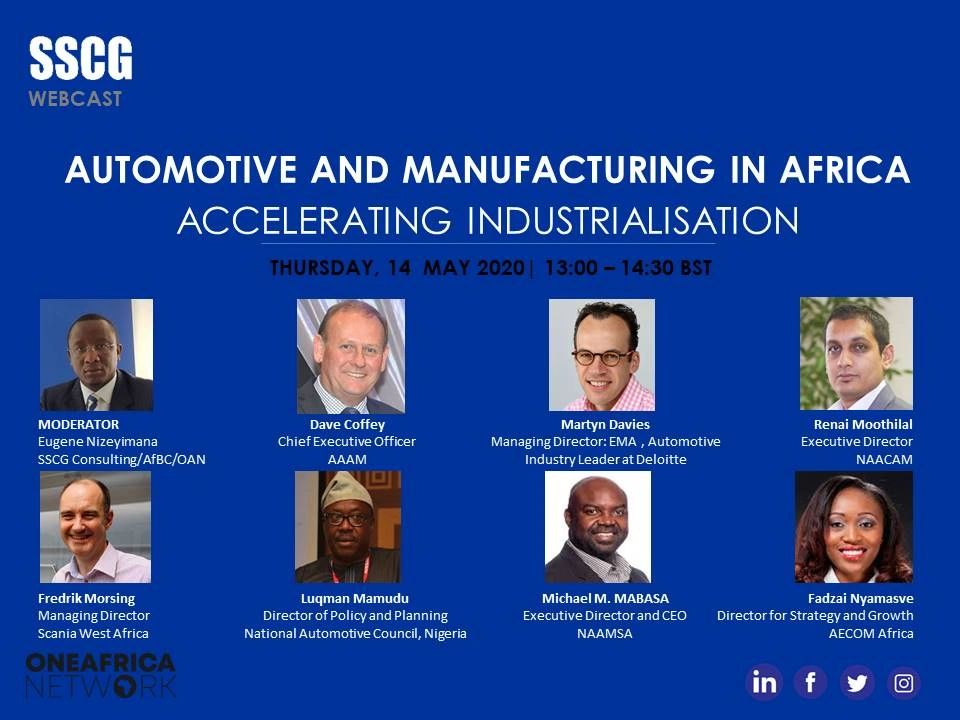
Join us for SSCG Webcast: Automotive and Manufacturing in Africa - Accelerating Industrialisation live online panel discussion on Thursday, 14 May 2020 between 13:00 - 14:30 BST to gain latest update, perspectives and opportunities across the industries and region.

CEO and Managing Partner - SSCG Advisory, Consulting, Technologies and International Services
E: Eugene.Nizeyimana@sscg-group.com
T/M: +(44) 7873150562