Signed in as:
filler@godaddy.com

The global automotive, transport, and mobility ecosystem is at a critical inflection point, shaped by the convergence of technological innovation, evolving consumer expectations, and regulatory imperatives. Traditional automotive players are navigating a multi-dimensional transformation, characterized by the accelerated adoption of electrification, connectivity, shared mobility solutions, and autonomous driving (ACES) technologies. Governments across major markets are reinforcing sustainability mandates, driving aggressive emissions targets and incentivizing the transition to electric vehicles (EVs), while urbanization trends and shifting commuter behaviors are redefining transport demand patterns.
From an industry perspective, the automotive sector is experiencing unprecedented disruption across its value chain. Original Equipment Manufacturers (OEMs) are recalibrating investment priorities to integrate advanced powertrains, software-defined vehicle architectures, and mobility-as-a-service (MaaS) offerings. Suppliers are repositioning from traditional component manufacturing to technology-driven partnerships, focusing on battery systems, sensors, and data analytics capabilities. At the same time, new entrants including technology giants and startups are challenging conventional market dynamics by leveraging AI, cloud computing, and digital platforms to enable seamless, connected, and sustainable mobility solutions.
Market dynamics are further influenced by global macroeconomic factors and geopolitical developments. Supply chain volatility, trade tensions, and the need for localized manufacturing strategies are compelling stakeholders to build resilient and flexible operations. Meanwhile, evolving consumer preferences particularly among younger demographics prioritize convenience, sustainability, and integrated mobility experiences over vehicle ownership. The convergence of these factors is accelerating ecosystem partnerships, cross-industry collaboration, and the emergence of platform-based business models.
Looking forward, the sector is expected to witness continued investment in EV infrastructure, battery technology innovation, and the deployment of autonomous mobility solutions in urban environments. Competitive advantage will increasingly depend on capabilities in digital ecosystems, data monetization, and adaptive supply chain management. Stakeholders who successfully balance innovation, regulatory compliance, and operational efficiency are positioned to capture significant value in an increasingly complex and fast-evolving mobility landscape.
The automotive, transport, and mobility sectors are navigating an era of unprecedented disruption, driven by electrification, autonomous technologies, digital ecosystems, and evolving consumer expectations. Driving growth requires an integrated approach that balances market expansion with portfolio optimization, leveraging data-driven insights to capture emerging revenue streams, unlock operational efficiencies, and accelerate go-to-market agility. Innovation is central, with a focus on connected mobility solutions, advanced propulsion systems, and platform-based business models that enable rapid scaling while creating differentiated customer value.
Transformation and resilience are critical imperatives as industry players contend with supply chain volatility, regulatory pressures, and shifting energy landscapes. Leading organizations embed agility at every level, invest in flexible operating models, and adopt scenario-based planning to anticipate disruptions. Sustainability is no longer optional; it is a strategic lever for competitive advantage, encompassing carbon-neutral operations, circular value chains, and sustainable mobility solutions that align with stakeholder expectations. By integrating growth, innovation, transformation, resilience, and sustainability, organizations can future-proof their operations while shaping the next frontier of mobility.


Join upcoming online conversation on accelerating the development of African automotive industry, vehicle manufacturing, Electrical Vehicle (EVs) batteries manufacturing and BESS supply chain, Auto technologies, innovation, e-mobility, unlocking untapped investment and growth.
The increasing global competition necessitates intelligent manufacturing systems integrated with adaptable logistics systems. Which can be readily adapted to meet the growing demand for model diversity. At SSCG, we help automotive companies develop strategies and integrate innovative technologies to increase their core strengths, productivity and efficiency. Identify the appropriate supply chain models and design alternatives to meet manufacturing challenges efficiently at cost, quality and timely.
The automotive industry is very dynamic and requires extreme flexibility, adaptability and agility. The benefits of manufacturing processes digitisation are quite clear as robotics and automated processes provide high levels of accuracy, efficiency, productivity and to accomplish more complex engineering tasks. We support our clients asses their manufacturing capabilities, plan to stand in the competition, cope with developments around Industries 4.0, demographic change and data-driven production.
Micro mobility sector in Africa encompass a strong customer base and has done so roughly two to three times faster than either car sharing or ride hailing. The sector has been core for intra and inner cities transportation across the region and continues to grow. In just a few years, several micro mobility start-ups have been launched. However the sector faces constraints include its suitability for relevant mobility use cases, safety control, customer adoption, vehicle age fit, low carbon emission control, congestion and traffic management and micromobility’s lower presence in rural areas.
To stimulate African automotive manufacturing and assembly localisation, industrialisation and growth of local market for new vehicles, traditional dealership models and aftermarket must be transformed to limit the volume of imported second hand vehicles and components imported. Favourable policies, framework and strategies should instituted.
Top automobile manufacturers in Africa
Rolls-Royce Power Systems business unit is opening its headquarters for East Africa in Kenya.
Isuzu East Africa has launched a $3.5M Ultra-Modern Paint Plant.
Africa’s automotive market is expected to grow by 40 per cent to reach $42.06B by 2027.
Africa’s automotive market size is expected to grow from 1,325.89 thousand units in 2023 to 1,777.69 thousand units by 2028.
Auto and mobility business services can generate value in multiple ways; by accelerating growth, improving margins, increasing income stream predictability, and boosting both customer and product intimacy. Beyond these evolving stakes, companies must move proactively to capture the next opportunities: Use digital technologies to increase technical and customer experience and adopt connectivity-driven commercial models to capture consumer data to aid planning and decision making.
Given high commodity prices and the predicted tight supply of nickel and cobalt in the coming years. Recycling EV batteries can make sense as battery electrodes contain highly valued metals. While having an additional source of battery metals through recycling can be compelling to battery makers looking to secure supply, it is critical now to develop a recycling process that is sufficiently cost-competitive with mining for the path to gain scale. However, to unlock this new pool of battery supply, four challenges in repurposing must be overcomed while battery-ownership models evolve: battery-pack design size, falling cost for new batteries, second-life-battery quality or performance standards and immature regulatory regime
We have been supporting Vehicle OEMs to transform and improve new product introduction (NPI) and manufacturing assembly process (MAP) to enhance product quality and operation excellence.
We have been supporting our premium global OEM client in the UK to enhance product quality, customer satisfaction, concepts quality strategies and processes.
We have been supporting a new indigenous vehicle manufacturing and assembly company is South Africa with strategic planning, vehicle programme planning, manufacturing and supply chain process set up.

The Africa Automotive Show is the gathering place of all of Africa’s automotive leaders, policy-makers and buyers, as well as international partners. It represents an unmatched opportunity for brand building, sales and partnerships.
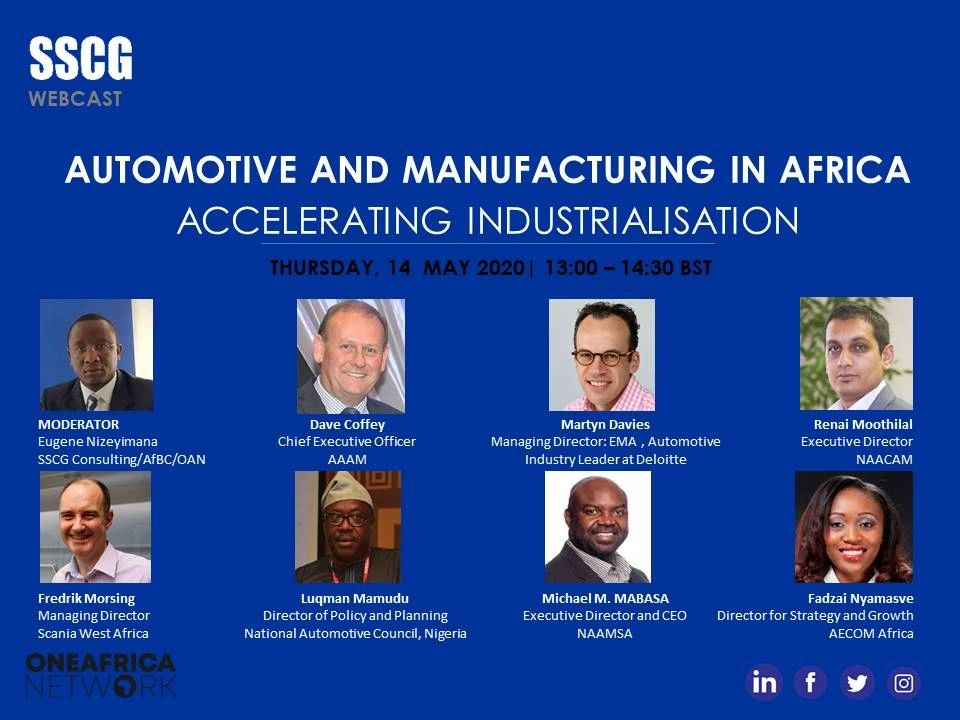
Join us for SSCG Webcast: Automotive and Manufacturing in Africa - Accelerating Industrialisation live online panel discussion on Thursday, 14 May 2020 between 13:00 - 14:30 BST to gain latest update, perspectives and opportunities across the industries and region.

CEO and Managing Partner - Consulting, Automotive, Energy and Technology Services